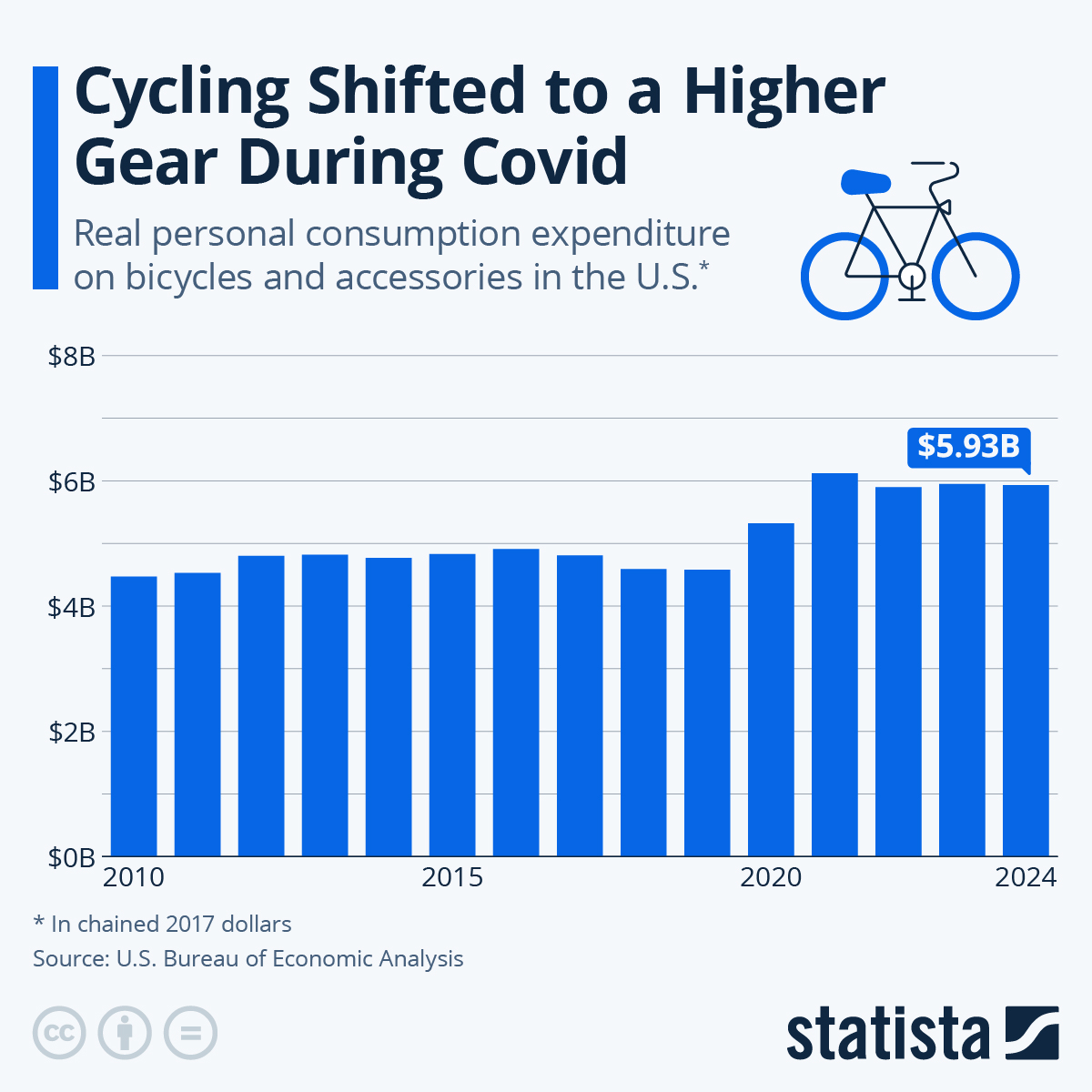
In the United States, a firmly car-centric society, the bicycle plays a relatively minor role compared to large parts of Europe, where people are much more likely to rely on their bikes for everyday transportation. During the Covid-19 pandemic, however, which forced gyms to shutter and public transportation to suspend operations, millions of Americans re-discovered bicycles as a safe, socially-distanced form of physical exercise and transportation. The bike boom hit retailers unprepared, causing new bicycles to become a scarce commodity, exacerbated by the fact that global bicycle supply was also constrained due to Covid-19.
As our chart shows, the pandemic-induced bicycle boom wasn't just a fad. Bicycle-related consumer spending has remained at a higher level ever since, averaging $6.0 billion between 2021 and 2025, up from $4.7 billion between 2015 and 2019, according to inflation-adjusted figures published by the U.S. Bureau of Economic Analysis. In 2025, Americans spent a record amount of $6.2 billion on bicycles and accessories, up 36 percent compared to 2019.