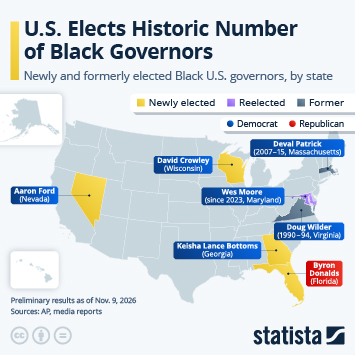
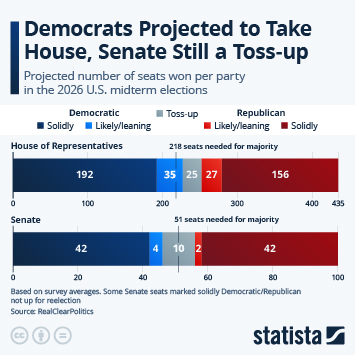
A total of 22 Democrats have been declared the winners of their gubernatorial races in the 2026 midterms, bringing the number of Democratic governors and governor-elects to 28. This could rise to 30 as Democrats also lead races in Kansas and Alaska that are still being counted. Democrats flipped gubernatorial seats this election cycle in Georgia, Iowa, Nevada, Ohio and Texas and could add Alaska.
The end result could yield a net gain of up to six governorships for Democrats. At the beginning of this year, Democrats had only held 24 governorships, rising from 23 with the win of Abigail Spanberger in Virginia at the end of 2025.
Which party holds the most governorships normally follows an anticyclical pattern. After Barack Obama won the presidency in 2008, Republicans began to gain the upper hand in gubernatorial elections starting in 2009 and creating a record 34 Republican governors at the end of Obama's second term in 2017. Likewise, most governors in the U.S. were Democrats during the second term of the Bush presidency (2005-2008) and most were Republicans during Bill Clinton's time in office (1993-2001).
The shorter first presidency of Donald Trump didn't have the same effect on gubernatorial races. Even though his party lost seven governor seats between 2017 and 2020, for example in Wisconsin, Michigan and Illinois, Republican governors remained in the majority throughout Trump's term. Democrat Joe Biden, another one-term president and, like Trump, an unpopular one, saw the number of Democratic governors fluctuate only slightly while remaining in the minority between 2021 and 2024. The first two years of Trump's second term saw much of the same stagnation.